


Pennant Hills AFL Club History
Every Heart Beats True
The Pennant Hills Demons’ history has been shaped by talented players, dedicated volunteers and a strong connection to the local football community.
The Club wears the navy blue and red of Melbourne Football Club’s oldest traditional playing strip and shares the Demons name with its sister club, the Melbourne Demons (AFL). Its motto, “Every Heart Beats True,” reflects the loyalty, friendships and sense of belonging that generations of players, families and supporters have experienced at Penno.
Throughout its history, Pennant Hills has established itself as a successful Sydney Football Club and a respected developer of young talent, with many players progressing to AFL and VFL football.
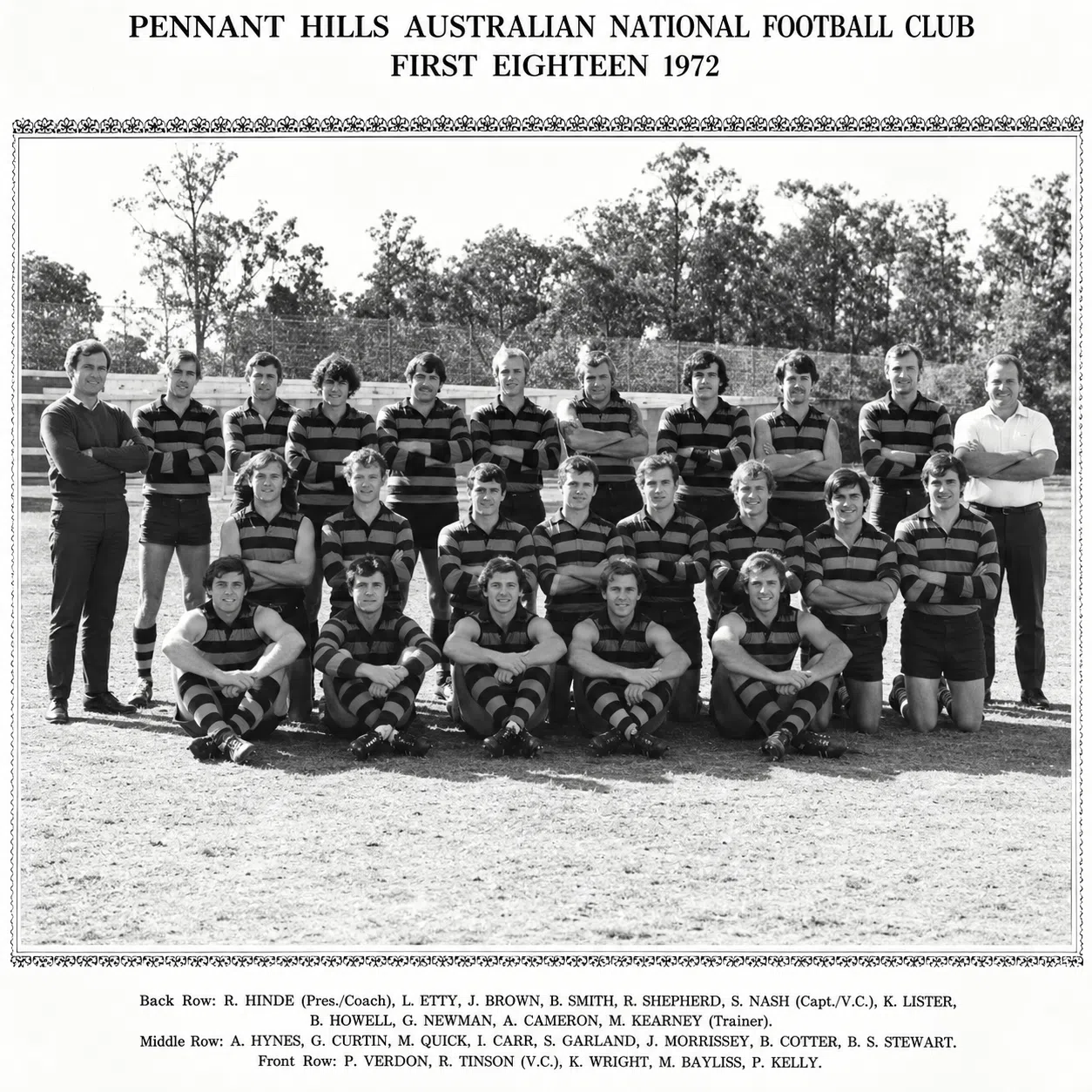
The Early Years
Australian Rules Football was established in Pennant Hills in 1966, with the formation of the Junior Club. As those young players approached the end of their junior football years, it became clear that a senior club was needed to provide somewhere for them to continue playing.
Kerry James and the late Ern Holmes were instrumental in establishing the senior Club. Pennant Hills played its first season in 1971, competing in Third Division and finishing third.
The Club moved into Second Division in 1972, finishing fourth, before recording consecutive runners-up finishes in 1973 and 1974. Its first premiership followed in 1975. Across the 1975 and 1976 seasons, Pennant Hills put together a remarkable 33-game winning sequence.
The People Who Helped Establish the Club
Kerry James contributed as a player, served as Captain-Coach in the inaugural 1971 season and is recorded in the Club’s history as President from 1972 to 1975. His connection to Pennant Hills continued through an ongoing interest in the Club and sponsorship support.
Ken MacRae became involved during the Club’s formative years as both a player and an administrator. The historical account records his presidency from 1976 to 1981. He also served for several years as Chairman of the NSW Football League. Beyond his administrative contribution, Ken supported the Club as a sponsor and, for many years, supplied its first-aid and medical requirements at no cost.
Ern Holmes remained actively involved in the Club until his death in 1985. In 1989, Number Two Oval at Pennant Hills was named Ern Holmes Oval, recognising his lifetime contribution to local sport and, in particular, Australian Rules Football.
Promotion to First Division
Throughout 1975 and 1976, Pennant Hills made repeated applications for promotion to First Division, later known as Premier Division. Those applications were unsuccessful.
An opportunity arose in early 1977, when South Sydney was unable to field a First Division team. With just 30 days before the season began, Pennant Hills was invited to join the competition. A condition of admission was that the Club also field an Under 19 team.
The Demons made an immediate impression. Their first, First Division match was played against North Shore at North Sydney Oval, with Pennant Hills recording a 29-point victory.
The 1982 Grand Final
In 1982, Pennant Hills’ First Grade team finished runners-up to East Sydney in the Grand Final at the Sydney Showground, then located at Moore Park. The Club’s account recalls a wet and miserable day, with hopes of a first First Grade premiership ending as the ball stopped in the mud in the goalmouth at full-time. It remains a memorable moment in the Club’s early history.
Recruitment and the Arrival of New Players
Club folklore tells of players and officials standing at the traffic lights in Pennant Hills, flagging down vehicles with interstate number plates in the hope of finding new footballers. During the 1980s, mergers between Sydney-based companies and their interstate offices brought many footballers and their families to Sydney, particularly the Hills district. Pennant Hills’ reputation as a warm, friendly and family-oriented club helped attract players and parents to both the junior and senior clubs, with a particularly strong connection to South Australia.
Former Hawthorn player Wes Smith played for Pennant Hills from 1976 to 1978. Former Essendon player Pat Wellington arrived in 1980 following a recruitment campaign that included an employment opportunity provided by a Club member. Other recruits included Russell Mathison, whose federal parliamentary service is noted in the original history, and Gary Spillane.
A recruitment advertisement in Melbourne’s The Age newspaper in 1990 brought Danny Ryan and Tony Regan to Pennant Hills. Both became important figures in the Club. The Club’s reputation continued to attract South Australian players during the 1990s, including Trevor Clisby, Kim Klopp, Peter Bennett, Tim Noonan, Greg Byrne and Richard Gerke. Adam Grossman also joined from another Sydney club. Their arrival helped lift playing standards at an important stage in Pennant Hills’ development.
Strong Connections with Junior Clubs
Pennant Hills established itself as a senior football destination for players from the strong junior clubs at Pennant Hills, Westbrook and Hornsby. The coaching, development and support provided by these junior clubs have been fundamental to the senior Club’s growth. Their contribution is an important part of the Pennant Hills story and remains greatly appreciated. The Club also attracted junior players from the Central Coast who were looking for opportunities to compete at a higher standard. Rod Miles is recognised in the Club’s history as a NSW AFL Hall of Fame inductee.
Rod began playing senior football in 1972, aged just 16, and won the Club’s Best & Fairest in both 1972 and 1973. He played 233 senior games, a mark subsequently surpassed by Chris Yard. His contribution extended beyond playing. Rod coached the Under 18 team and remained involved with the Junior Club as a coach and committee member.
From Ern Holmes Oval to Mike Kenny Oval
The Spiritual Home of Penno
Ern Holmes Oval, affectionately known as “The Ern,” holds a special place as the Club’s spiritual home.
In the 1970s, its facilities were relatively basic for Australian Rules Football. Improvements were made over time, including an extension to the amenities block. The ground became known for its intimate atmosphere, with supporters close to the boundary and excellent viewing from the hill.
As Cherrybrook developed, Club officials saw an opportunity to establish a full-sized AFL ground. According to the Club’s history, the proposal was undermined by public rumours that the Sydney Swans would use the ground as their home venue. Although the senior Club’s plans did not proceed at that stage, the ground was developed and became the home of Westbrook Junior Club.
Following the setback involving Francis Greenway Oval, now Mike Kenny Oval, Pennant Hills returned its attention to expanding Ern Holmes Oval. Plans included widening the playing surface and upgrading the amenities. Numerous options were considered, but limited funding and the ground’s position within the congested Pennant Hills Sports Complex made significant expansion and improvement extremely difficult.
A New Home in 2011
Although other Sydney Football League clubs and their supporters were comfortable playing at The Ern, the NSW/ACT AFL Commission determined that the ground was unsuitable for Premier League football.
In 2011, the Club’s long-held ambition for a suitable home ground became a reality. Cooperation with Westbrook Junior Club and Westbrook Giants Baseball Club, together with financial support from the AFL, Hornsby Council, Pennant Hills and other ground users, enabled Mike Kenny Oval to be upgraded to a standard accepted by the Commission.
Mike Kenny Oval became the Club’s home ground, fulfilling a vision that had first taken shape in the 1980s.
Leadership and Administration
Sound administration has played an important role in the Club’s development. During its formative years, Kerry James and Ken MacRae provided leadership that helped establish a strong foundation.
Tony Yard and Lindsay Thomas served as Presidents across the period 1990 to 1997. Under their leadership, the Club’s financial position improved sufficiently to set aside funds for proposed improvements to Ern Holmes Oval. During the mid-1990s, the AFL undertook a comprehensive review of football and its development in New South Wales. A new commission was established in 1996, with Ross Howarth appointed as a commissioner, a position he held for many years.
Over several years, the NSW/ACT AFL Commission provided financial assistance to Sydney First Division clubs. This support helped Pennant Hills engage professional administrative assistance and a business manager. From 2001 to 2006, the Club benefited from Leo Browne’s business experience, guidance and direction. Leo and his companies also provided substantial financial support.
Pennant Hills’ achievements on and off the field have been recognised through the League’s Club of the Year award on numerous occasions
Players Who Progressed to AFL and VFL Football
Pennant Hills’ record of developing players has earned it descriptions such as a “Hotbed” and “Footy factory” of Australian Rules Football in Sydney. The existing history records the following players and AFL/VFL club connections. These are both current and historical associations.
| Player | AFL/VFL Club Connections |
|---|---|
| Terry Tripp | Sydney Swans |
| David Brown | Sydney Swans |
| Stephen Carey | Sydney Swans |
| Lenny Hayes | St Kilda |
| Mark McVeigh | Essendon, Sydney Swans (Coach), Essendon (Coach) (CURRENT) |
| Kieran Jack | Sydney Swans |
| Brandon Jack | Sydney Swans |
| Kieren Briggs | Greater Western Sydney Giants, Richmond Tigers (CURRENT) |
| Braeden Campbell | Sydney Swans (CURRENT) |
| James Peatling | Greater Western Sydney Giants, Adelaide Crows (CURRENT) |
The history also recognises Ray Hall and Jarrod McVeigh as listed players who came through the Junior Club. Scott Reed and Blake McGrath were associated with Collingwood and St Kilda, respectively.
The Volunteers Behind the Club
Hundreds of volunteers have helped build Pennant Hills over the years. Their contributions have been too numerous to recognise individually, but every role has mattered. Scoreboard attendants, canteen volunteers, timekeepers, strappers, committee members, team managers, coaches, runners, water carriers and many others have given their time to support the Club. Whether working on match day or behind the scenes, their efforts—large and small—have helped make Pennant Hills a leading club in Sydney Football.
On-Field Success
Premierships
| Grade | Premiership Years |
|---|---|
| Under 19s | 1993, 1994 |
| Under 18s | 1996, 1999, 2003 |
| Reserve Grade | 1994, 1996, 2018 |
| Division Three | 1975, 2001, 2003, 2007, 2008 |
| First Grade | 2000, 2006, 2008, 2015, 2017 |
| Women’s Division 2 | 2022 |
