


ARTICLE: The Pennant Hills Demons Premier Women’s Aussie Rules Team – Club, Team, Teammates, Self (Written by Patrick Skene)
August 25, 2026
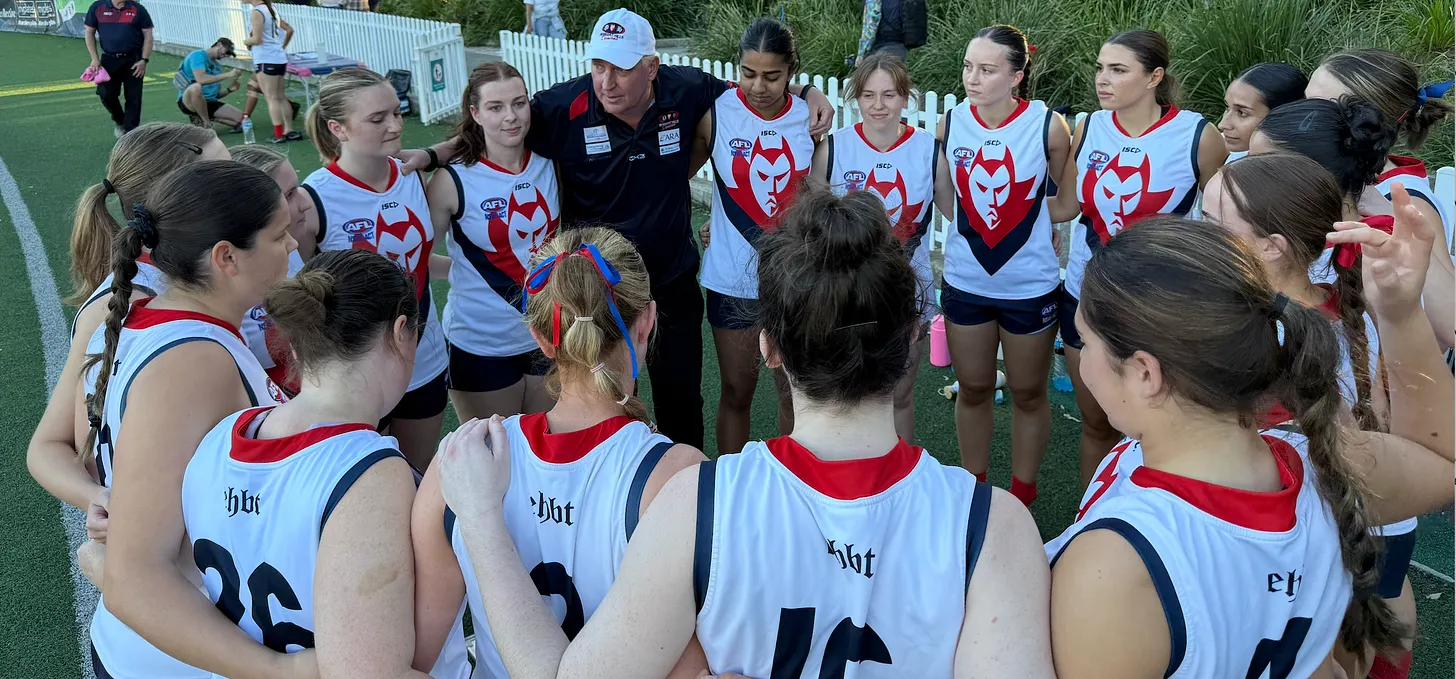
The Pennant Hills Demons Premier Women’s team have not won a game since 24 July 2024, a losing streak that will stretch to thirty-six matches when they finish their last game of this season. This year the club marks ten years of women’s football for the club. Crippled by a player exodus and multiple coaching changes, a player shortage has led to more than 30 lower graders doubling up for their Premier Grade sisters, playing two games in a single day. Despite the continued beatings, they come back to training every week with a smile. They are holding the line until the cavalry arrives. This is their story.
Written by Patrick Skene. Read the full article via Substack HERE.
“In the midst of winter, I found there was, within me, an invincible summer.” French writer Albert Camus
It is a bright, late winter Saturday afternoon, and out at Gore Hill Park in St Leonards on Sydney’s lower north shore, the Pennant Hills Demons Premier Grade Women’s side are about to play their final game of the 2026 season. The ground sits beside the Royal North Shore Hospital and is artificial turf and unforgiving, the kind of surface nobody looks forward to playing on.
The team is watching closely for soft tissue injuries, carpet burns that can get infected and avoiding the occasional souvenir left by dog walkers. Their opponents are the second-placed North Shore Bombers, who boast a record of 13-2 this season.
The Bombers are the defending champions of the Women’s Premier Division and are expected to show no mercy to their beleaguered opponents who are winless and have scored one goal in their entire season. The Demons who will run out today have not tasted a win in more than two years in the Premier grade, yet unbelievably this is not a scene of despair.
Eighteen of the twenty-one Premier players were at Manly first thing this morning, playing a Division Three finals-decider which they heartbreakingly lost by two points. Their Division Three finals dreams are over and they could have made it, but for three forfeits earlier in the season supporting the Premier team. Some went for a picnic at Manly Beach before backing up for a full game again in the Premier Division.

A North Shore Bombers parent sitting next to me lets me know that the Bombers coach has set a target of 200 points for his team today to keep them motivated. The 2026 Minor Premiers, the Manly Warringah Wolves, had thrashed the inexperienced and outgunned Demons 197-0 just two rounds earlier. Of course North Shore want to go one better than their probable grand final opponents and crack the 200 mark.
It is looking grim for the tired Demons players who have a losing streak of thirty five games in a row over the past 3 seasons, but you wouldn’t know it watching them do their warmup drills.
The siren sounds and the game commences and Pennant Hills bravely hold off North Shore before they kick their first goal after ninety seconds.
It’s going to be a long afternoon for the women in white, playing in their alternate strip today due to the red and black colour clash with the North Shore Bombers. To understand how a team can have a season record of 8 points for and 1772 against and still run onto the ground smiling, you have to understand the club they play for and the ten years of women’s football that have led to this extraordinary afternoon.
* * *

Behind every good club that values its history is a keeper of the flame. In the Demons case it is John Acheson, the club historian.
Acheson says the first competitive footy kick in the Hills District came in 1966, when a handful of locals founded the Pennant Hills Junior Australian Football Club, the first Aussie rules club in the north-west suburbs of Sydney. The founders were Ern Holmes, Ken Telfer, George Brack and a twenty-five-year-old Balmain player named Bill Carey.
The club was born in a living room, in this case the front room of Bill Carey’s mother’s house at North Turramurra. Pennant Hills began their journey as underdogs. Their first team was an Under 13 side with an average age of about ten. The youngest was seven. Carey was their first coach.
In their first match they were beaten by Ermington by fifty-three points, 8.6 to 0.1, but the result didn’t matter – a beautiful journey was underway. The senior club followed in 1971, driven by Kerry James, who had transplanted from Melbourne and coached the Under 17s. James wanted somewhere for his graduating juniors to keep playing.
They entered a single side in the third division of the Sydney competition and made the finals in their first year. A local newspaper of the day called the team: “the mouse that roared.”

In 1974 the club dispensed with its green-and-gold hoops and adopted the red and blue of the Melbourne Demons Football Club and after running a nickname competition, the hot favourite ‘Demons’ prevailed. Back-to-back second-division premierships followed in 1975 and 1976, and in 1977, Pennant Hills scrambled together an Under 19 side and was promoted to the First Division.
The men’s first-grade side would not win its own premiership until the year 2000, twenty-three years later. All up, the club has won forty-nine flags, and the men’s senior side today sits in the top four of Premier Grade without paying a cent to a single player.
That is the foundation the women’s program was built on. And in 2016, after girls had spent decades sneaking a game in the boys’ teams until the cut-off at Under 14s, Pennant Hills fielded its first women’s side.
Acheson has watched every era of the club. Asked about the current Premier side, his verdict is sombre. “I feel very sorry for the girls. We have a proud history but it’s a tough time.” He says.
* * *

The women’s story has its own founder, and his name is Daniel Fiedler, known to everyone as ‘Fid’. A former Demons player forced to give up the game he loved after a life-threatening illness, Fiedler volunteered to coach the club’s first women’s team in 2016 and stayed for eight seasons.
Alongside him was a devoted team manager and runner, Allen Abbott, who patrolled the boundary in pink and whose players proudly called themselves “Al’s Angels.” That first side, in Division One, won five of fourteen games and finished eighth of eleven. In their second season, 2017, they won ten of seventeen and made the club’s first women’s final, beating the East Coast Eagles in an elimination final before bowing out.
A second team came in 2018 and a third in 2019. A fourth followed in 2020, and that same year the club was elevated to the Women’s Premier Division, the top tier. Their first senior win at that level came at Trumper Park in July 2020, a thirty-three point victory over UTS.

The high-water mark arrived on Father’s Day, 2022, at Henson Park, when the Demons’ Division Two side became the first Pennant Hills women’s team to win a premiership, edging Penrith by two points in a heart-stopper played in mud and a stiff south-westerly. Against the wind, from the goal square, the first major of that grand final was kicked by full-back Ashleigh Grubba, who kicked the second one too. When the siren sounded, close to a hundred ‘Penno’ supporters stormed the ground.

Three women have since reached a hundred senior games in the red and blue. Eleanor Rugg, a captain and pioneer, in 2023, and Hayley Lowe in 2024. Last Saturday, a third, Dani Cahill, brought up her own century milestone. She has told teammates she wants to come back next year to chase the club record of a hundred and four matches. Dani plays in the back line, so she sees a lot of the ball, often sailing over her head and between the sticks.
Sometime after that 2022 premiership victory, the summer turned to winter.
* * *

Starting in 2024, the club made the hard call to make some changes to the women’s program to enhance the ‘one club culture’. The changes left just eight Premier Division standard players remaining at the club. Most Women’s Premier Division Clubs have a squad of around 40 higher standard players to choose from. The Demons were faced with a long season with less than a quarter of that.
It was a decision Todd Williams, the former president who now works in club development for the AFL and coaches the Division Three side, describes as: “protecting the club through better communication chains and coordinated effort.” On top of that upheaval came a run of three Premier Grade coaches in two years, including one appointment that did not fit that had to be ended mid-season, only weeks ago.
The result of the off field turbulence has meant an outclassed team getting consistently beaten. The Demons Premier women’s side have not won a game since 24 July 2024, an excruciating 759 days. In 2025 they played sixteen matches and conceded 1,724 points while scoring 24.
In 2026, across fifteen matches, prior to their final game, they have conceded 1,772 and scored 8 - one goal and two behinds for an entire season. Over two years, they have conceded close to 3500 points and scored 32 at an average of less than a point a game.
When they run out on Saturday their losing streak stands at thirty-five games. Williams has coached a men’s Division One side to a grand final. He is a hardened footy man and he says, without hesitation, that being involved with this group fills him with joy.
“I haven’t been prouder of a group of players than I have of this team because of the hardship they’ve gone through.” Williams says. The club’s motto, printed on everything, is club, team, teammates, self, in that order.
Williams reckons this group has lived it more completely than any side he has seen.
“The girls are able to cope with this because it’s much more than footy – it’s a social network.” Williams explains of the team culture that transcends results. He notes a difference he has observed within his club.
“The women want the fun and the connection, and then they play well. The blokes want to play well before they make the connections.”
* * *

If Williams is the club-development brain, the president, Stewart Woodward, known to everyone as ‘Woody’, is its heart. He has been at Pennant Hills about a decade, arriving just before the women’s program started, back when the first training sessions were half a dozen girls and a bag of footballs.
He took on the presidency this year, in the middle of the storm, and he is unromantic about the position the senior women are in - they simply do not have the player quality to match the other teams. But ask him about the Division Three girls who volunteer, week after week, to back up and play a second game for a Premier side that they know will be flogged, and he becomes emphatic.
“These girls, they live our motto every weekend. They could quite easily join other clubs or just stick to their own division three team. But they don’t. They back each other up.”
“They live our culture better than the men,” Woodward says.
“The men are talented and live by the ethos too, but they’re not put in a difficult situation like the women are. The women have to basically display it every weekend.”
He admits he has sat in the stands during some of those games and wondered how they do it.
“I know there’s quite a few blokes who wouldn’t do that. They’d walk straight off.”
He is careful to frame this phase of the program as a key part of a longer game. Pennant Hills does not pay players.
It builds them, through the juniors and the pathways, and it draws people from as far as the Central Coast and Newcastle who come not for money but for the structures and the absence of what Woody calls “poisonous cliques”. Past players stick with the club. He points out that at a recent function, more than 120 past players turned up to celebrate the club’s history, the function bursting at the seams.
“That reconfirmed to me what we have – a durable, strong community club that people care about, that can survive some tough patches.”
In five years, with the juniors coming through, he expects the women’s program to be a genuine powerhouse.
“We couldn’t build to the next phase without these girls having to go through this pain.” Woodward says. “At the end of the day, the club and the team come first, and themselves comes a distant third.”
* * *

The leader the Demons players look up to for inspiration is Amelia Bennett, twenty-three, the women’s program captain, a hard-ball-winning midfielder whose playing style coach Wilko compares to a “raging bull”. Bennett found footy through the Paul Kelly Cup in primary school and fell for it completely, at a time when there were no girls’ teams.
“I don’t care if I have to play with the boys,” she told her mum, “but it’s going to happen.”
She played for the Baulkham Hills Hawks and trained with the East Coast Eagles as a fourteen-year-old just to get her foot in the door. In 2023 she did a single trial at Pennant Hills and never looked back. Within a year she was captain. She has held the role for the last two. Her role model is Amanda Farrugia, the former GWS Giants captain, whom Bennett used to walk down to her local oval to find, hoping she’d be there for a kick.

Farrugia showed her, she says, that giving back to the game matters as much as playing it. It is a lesson Bennett has taken to heart with her own young team. This year, in a game, she snapped her ankle and tore four ligaments, a season-ending injury.
It was not her first ankle trouble. She had torn the ATFL and CFL ligaments several times across both ankles, strapping them up and playing on. This time was far worse. A snapped ankle and four torn ligaments, including the Interosseous and the anterior inferior tibiofibular ligament (AITFL), which put her in a moon boot around the clock for six weeks.
When it happened, ignoring the pain in her ankle, she ran off the field furious, then had to face the truth.
“I had a chat with Wilko, and a few tears at first,” she says. “It was pretty hard to face the music.”
She still drives down from the Central Coast every week to be at training and on the sideline. She’s here at the ground today, dressed in pink ready to perform a role for the coach running out instructions.
“Just because I’m injured doesn’t mean I shouldn’t be there for the girls. I still need to lead.” She says. “I’ve got to put on a smile for the girls and show them an injury is just temporary. If you’re putting in the work, you come out the other side stronger. I’m not dead, I’m not in the hospital.”
When she speaks to a team getting beaten by a hundred and fifty points, it’s never about the scoreboard, it is about resilience and strength.
“It takes a really strong person to stick around when you’re losing every single game by a lot,” Amelia says.
“I’ve been at clubs where you win every game and don’t feel part of anything. Winning isn’t everything.”
She sets small, achievable goals, like holding them scoreless for seven minutes or stringing four kicks together, and watches the confidence grow slowly.
And she insists, over and over, that: “the scoreboard is a liar.”
“I don’t believe the scoreboard reflects how our girls have played. You can see what we’re becoming in those little moments.”
* * *

You will hear the Demons’ Premier Grade number one fan before you see him. Jeremy Bennett is an American, from just north of Salt Lake City in Utah, who arrived in Sydney in 1996 knowing nothing of the game.
He was taken to an NRL match.
“I found it too much like the same play fifteen times over, and then had a few Victorian mates drag me to the AFL.” He recalls.
“What is this skilful madness?” he remembers thinking. He has barracked for the Swans ever since, and for his daughter Amelia louder than anyone.
Where some parents go quiet when their kid’s team is a hundred and fifty points down, Jeremy does not. He puts it down to something in his American DNA.
“You fight to the siren. That’s what I tell Amelia. You play with everything you’ve got till you hear that last horn.”
He has watched his daughter step back, in ladder terms, from winning sides to a club being beaten senseless, and he has never been prouder, because he understands what she went looking for and found.
“They put the ladder down for the girls who wanted to climb up. They give all the girls a warm welcome. That was the difference. And the girls this year have been all heart.”
As for the girls doubling up, jumping from thirds to the top grade in the same afternoon, the American loves the players’ mentality of club first. “They know the Prems team is the most important thing to keep the club going. If you forfeit that, none of the other points count.”
“So we’ve got to keep this club together until the young ones develop and we’ve recruited more girls that are ready.”
* * *

Down in the last line of defence, absorbing wave after wave of relentless attacks, is fullback Ashleigh Grubba, vice-captain and five-year veteran, the same player who kicked those two goals in the 2022 Division 2 grand final.
She came to the game raw at fifteen, fresh out of junior netball, invited along by a friend to the junior club and with no AFL in her family at all. She stayed for the thing so many of them name first - the culture.
“AFL’s got a really good culture compared to other sports. There’s a lot of strong social life outside of it. That’s what I really enjoyed.” Ask her where she finds a win in a season like this, and she takes comfort in any improvements.
“We try not to look at the scoreline. We look at the things we’ve improved: our handball, our kicking efficiency. Small parts of the game.”
Her proudest recent moments seem small to an outsider. Holding the University of New South Wales to under a hundred points, ninety-eight in the end, after they set the target at half time. A Division Three player called Claudia kicking her first-ever goal (and the only goal of the season) in her first Premier grade game.
When it went through, Grubba says, the team and fans were delirious. “We celebrated like we had just won the grand final.”
“That’s what we do.” She says.“You can’t build a strong Prems team overnight,” Grubba says of the need for patience. “So we all have to stick around and work towards building the women’s program back up.”
Grubba has her work cut out today and she is everywhere. Her elite opponents, some of them in academies tower over her and every fibre of her being is rallied to stop them. There are lots of small wins, a hard tackle, a chain of handballs, a contested mark. She scraps hard with her teammates but the pressure is relentless. Her long clearing kicks can only go so far.
At half time the North Shore Bombers lead the Pennant Hills Demons 116-0. They are on track to crack the 200-points milestone, and the Demons seem unable to stop them.
* * *

Kate Quadrio is in her sixth season, one of the two longest-serving women at the club, and she is proof of the Demons’ habit of taking in strangers. She grew up in a rugby union family where AFL was, she says, considered lame and never watched.
During COVID, missing the social sport that leaves your life when school ends, she wandered down to her local club, Pennant Hills, having never picked up a ball, and after one training was hooked. She has ridden the whole rollercoaster, from Division Four to Three to Premier Grade, a doubling-up regular who relishes the extra game time.
Kate is proud to have reached the 50-game milestone this season and has a simple theory on why people look beyond results and stay at the club.
“So many people have had so many opportunities to leave. You could go to another club, play in a higher division and win more than you lose.” “But there must be something about us that keeps people here.”
That something, she reckons, is how good they are at what she calls “getting external”, the constant positivity and support, clapping and high-fives for a teammate who’s just fluffed a mark. “We celebrate every small win. Even if it’s just an amazing tackle or a really good kick.”

The women’s teams train together twice a week and eat dinner together every second Thursday. They throw a party they’ve made semi-famous called the Demons Disco.
“We bring good energy even though we’re losing, because you get to play sport with your friends. That’s just super enjoyable.” Kate says. Sadly, for today’s final match she is watching from the sidelines, courtesy of broken fingers she injured a few games ago. She’ll be willing her teammates on till the end – not to win but to improve and do the little things right.
“I can’t play with my fingers,” she says. “But I’ll be a runner or water carrier. I still get to watch and be part of it.”
* * *

The man with the whiteboard prowling the sideline for the Demons is coach Ian ‘Wilko’ Wilkins. He is an unrelenting force of positivity. Despite the scoreboard carnage he refuses to allow any negativity and the players feed off his staunch approach.
After the Demon’s previous coach left mid-season, Ian stepped up into the top job to help them to the finish line. He is an unlikely footy coach, an Englishman from Bath and a water polo player of thirty-odd years. Wilko came to Australian rules football through his children in 2017 and is also the current U20s coach, having miraculously nursed the team to the finals in their first year of existence.
With no replacement coach available he was not willing to let the Premier side down: “in the world they’re in at the moment.”He has no illusions about their last two years results. What he does have is player performance data from every Premier team’s match, which he turns into a handful of simple themes the girls can train to and measure themselves against.
He says it’s important that improvement can be seen even when the results are not there.
“They come off games and they’re literally just smiling and happy because they have improved.” He says.

“I’ve been in competitive water polo a long time. I know what it’s like to lose. But I don’t know what it’s like to lose by that many points, and still come off with this energy, this connectedness. What else can I ask of them?”
According to Wilko, more than thirty different women players have doubled up this season, playing in Division Three and then backing up against genuine Premier Grade opposition on the same day. Some have done it six times or more. He recalls one game day when two carloads of players played at Sydney University then drove as fast as they could to play at Manly. Held up by the Spit Bridge which was open, they arrived for their Premier Division match with five minutes to spare.
Wilko and Todd Williams made a deliberate decision to change the previous arrangement, under which the Division Three girls were made to forfeit games so the Premier side could field a team. In the first half of the season, the thirds forfeited three matches for exactly that reason.
The coaches flipped it: the thirds would play the football they signed up for, and the girls would volunteer to double up to keep the Premier side alive. Why keep a Premier side alive at all, when it is being obliterated every week? Wilko says that a forfeit at Premier Grade level could have jeopardised the club’s most important asset for the future.
“Without a functioning Women’s Prem team, we may not have got the licence. And these girls just keep on coming back.”
Wilko has written a paper that discusses a three year strategy, presenting options for the coming years including recruiting a full Women’s Premier Division list.
“I’ve called this season the pre-preseason,” he says watching the game intently.
“Preparing ourselves for the preseason, which is preparing ourselves for a fresh start in 2027.”
* * *

On the morning of the game I spoke to Georgia Garnett, the cult hero GWS Giants player who this season has been heavily involved in helping the Pennant Hills Demons Women’s program. She is on the sidelines at Manly watching the Pennant Hills Division Three team lose by a heartbreaking two points and miss out on finals.
Garnett is flying to Melbourne later in the afternoon to play for the Giants against Melbourne Demons in their AFLW match tomorrow, but she is supporting her girls. Garnett was brought in earlier in the season to help out at training, a role model link to the professional game.
She came through Sydney football herself, at East Coast Eagles, a Demons rival, and when AFL NSW floated a coaching opportunity with the Demons she put her hand up. When that contract ended and the Demons Premier coach was let go, she messaged Wilko and offered to keep coming down.
Ask her why she is so attached and her answer is beyond footy.
“I’ve never been around a bunch of girls who are so resilient and have so much care and love for each other,” she says.“That’s why I keep coming back. They come to training in numbers, happy as ever, wanting to learn.”
For Garnett, the players doubling up has been an incredible spectacle. “How good is that? One game is at 8:30 and the other at 4:30,” she says. “You can tell how much it means to them. And if it means a lot to them, it means a lot to me.”

She has deep empathy for their plight and her GWS Giants, she reminds them, have had their own tough losses and tough years.
“The scoreboard sometimes doesn’t reflect it, but their skill level and their understanding of the game is developing every week,” she says. “Whilst it is brutal right now, you have to show them they are improving and getting something out of this.”
Then there is the part she did not expect, what these girls have given back to her.
“These girls remind me why I fell in love with playing footy,” she says.“It’s the mates and the connection. And they are just a genuinely lovely bunch.”
After training one Thursday, the players got together and handed her a gift.“That’s not why you do it, but I appreciated it,” she says. “I feel the love from them every week.”
Has she fallen hard enough to forsake her previous loyalties in the Sydney AFL to one day turn out for the Demons?
“When I hang the boots up,” Garnett says.“I’d love to play with these girls.”
* * *

To boost morale, earlier this season, the club hired a bus and took the entire women’s program, Under 20s and Division Three and Premier girls together, to North Sydney Oval for the historic Australia versus Ireland AFLW international. The club calls it the party bus. They played their own games first, then did their post-match rituals, the Players’ Player and the team wrap, on the bus itself, on the way to watch the best in the world.
Although the Premier Grade team lost 72-0 to second-last St George, their closest team on the ladder, the girls partied like they had won. For many it was their first AFLW game in the flesh. For the youngest, it was a glimpse of a level they might one day reach.
“It was nice to have all three teams go out to the match. It inspires the younger girls to see what they can aspire to.” Wilko says. Amelia Bennett, in a moon boot at the time, could not make it, and suffered, what she calls, “enormous FOMO”. But she was thrilled at how many players went.
“You can imagine at some clubs that after copping so many losses, the last thing they want to do is spend their spare time together.” “Yet the more we lose, the closer we get.”
* * *

The North Shore Bombers continue to score goals at a fast clip with their pace, high skill levels and silky ball movement. Coach Wilko continues to plot and scheme, working his player whiteboard, managing the subs and sending his injured skipper, now runner, Amelia out with instructions.
There is no quit in these two.“I’ll be going out for a long night on the bevvies if we keep them below 200,” Wilko said at the start of the day.
As the scoreboard ticks over, it looks like it might be a slow night in front of the television. He sticks to his plan, celebrating whenever his players do something that they practice at training. A player turning and hitting a target, handballs strung together, a difficult mark.
The subs bench steadily dwindled with one player, Nat coming off with mangled fingers and after assessing the situation, walks across to the Royal North Shore Hospital to get them fixed.

As the scoreboard ticks closer to 200 for the North Shore, their players and fans become more animated, frenzied support of their team to breach the milestone. With a minute to go, the score is 197-0 and Wilko and Todd Williams can’t bear to watch. It is going to be a tight one.
And then it happens. Somehow the Demons rally, a couple of big tackles, some spoils, desperation level footy as if it is extra time in an AFL grand final. Somehow the Demons’ fighting spirit prevails, and they stand their ground against the seemingly inevitable Bombers.
The siren sounds. The Demons players scream for joy and celebrate with a dance. They have held their old arch rivals to under 200 points. The Bombers players and staff are silent, pipped at the post. A casual observer that just walked into the ground would have assumed the Demons had won a close one.
I can’t say I have ever experienced anything quite like it.
Wilko turns to me with a huge grin.
“It’s the small things.” He says.
* * *

I catch up with one of the players Dani Cahill, exhausted and emotional after playing earlier in the day. She has recently chalked up 100 games for the club and is closing in on the Women’s record of 104 games.
“Only two girls have done that before me and with the tough season we have had, it’s given us something to celebrate.” With tears in her eyes she tries to sum up what just happened in context of the season.
“This club is a family, it’s a community. I started late at 20 but it’s more than kicking a footy around.“You can go through hard times and come to footy and just forget it and have fun. We just can’t wait to get onto the field.”
She cannot say enough about the ‘Magnificent Thirty’ who have doubled up and played two games in a day during the season, sacrificing their own chances for Division 3 finals. “I’m sure some of these girls would play three games a day if it means that we keep the women’s program.”
* * *

In the Pennant Hills dressing room afterwards there is a sense of relief but the mood is also buoyant. They are overjoyed to have denied their opponents the milestone. They are the club’s cyclone-proof culture manifested.
Wilko goes around the team asking each of them for their favourite moments and the air is thick with defiant camaraderie and gratitude. He then addresses the team.
“I cannot tell you how lucky and thankful I am for the opportunity to coach you – it’s been an absolute privilege.” he says.
And then back to the unfinished business.
“I’m going to ask you to dig in for another couple of weeks to help the Under 20s out with their training sessions for finals.”
“And make sure to wash your grazes.”
The team whoops and cheers Ian and thanks him for his tireless efforts. From an outsider’s perspective, it’s difficult to imagine a worse season but none of it has broken these soldiers.
Their Under 20s are in finals. Their Division Three side sacrificed it’s season, forfeiting games in alignment with their philosophy – Club, team, teammates, self. More than thirty women have played two matches in a day, for no reward on the ladder, so that a licence for the future could be protected and a club could keep its shoulders up - the Magnificent Thirty.
And when the cavalry arrives next year, and the Sydney Football League begins, the Demons will stand tall because they held the fort through the harshest season the program has known.
As the old saying goes, patience is bitter but the fruit is sweet.
Ten years ago, a handful of women pioneers in borrowed jerseys ran out for the first time representing the Pennant Hills Demons and called themselves ‘Al’s Angels’.
On Saturday, their descendants ran out for their final game with joy and smiles knowing they were no chance of winning.Yet they played as hard and with as much commitment as any athlete in the world – the essence of sport.
They were channelling an immortal French writer.
In the midst of winter, there was, within these Demons, an invincible summer.
